
What was your filmmaking background before making "The Terrible Two?"
BILLY LEWIS: My background in filmmaking is a long road, as are most peoples who pursue this field. I got my college degree in Broadcast Journalism and worked in TV news for 5 years. Then I started my own production company doing TV commercials, web marketing videos, music videos, short films, etc. I wrote and directed “The Jailhouse” in 2009. That was my first big feature film, and I learned a lot from that. In between that movie and “The Terrible Two” (2017) I’ve learned so much about filmmaking and storytelling in general and I feel that knowledge helped me tremendously in creating what we think is an entertaining film in “The Terrible Two.”

Where did the idea come from and what was the process for getting the script ready to shoot?
BILLY LEWIS: My wife and I bought a house the year before we did the movie and the first time we walked through the house I noticed the amount of space in the house to move around and have lights, cameras, crew, etc. So I said to her that we would buy the house but on one condition.....that I was going to film a movie in it. She agreed but didn't believe me.
A year later I was kicking her and my girls out for 2 weeks (figuratively speaking) and we had a full crew ready and turned the house into a movie set. My wife Mollie was a real trooper to allow us to do that and for that I'm very appreciative.
As far as getting the script ready to shoot I had a really knowledgeable producer and first assistant director named Jonathan Landau who helped me out tremendously in tying up all the loose ends for production and tightening up the script so that it would be ready to make a good movie. The whole team we put together was amazing considering the fact that we had a very low budget on the film.
At what point did you decide to shoot in your own house and what impact did that have on the scripting?
BILLY LEWIS: As I said above the house was the basis for the entire movie so the script was built around the location. I like to look at the house as a character in the film and if you watch the entire movie then you know why. Knowing the location so well allowed us to be efficient when shooting and move at a rapid pace. We shot a total of 11 days and that’s pretty crazy.

What was your casting process, and did you change the script to match your final cast?
BILLY LEWIS: Our casting was pretty easy…with a few bumps in the road but that was expected. Early on I cast Reid Doyle as the lead actor, Albert Poe. He also came on as a very important producer during and after production. We had a lead female cast to play Rose and 2 weeks before production she got a higher paying job that she took (and I couldn’t really blame her) but that opened up the door for us to cast Cari Moskow who did an excellent job as Rose Poe.
Also, we had the 2 little girls cast and the night before we were supposed to shoot our first scenes with the girls something came up with them, so we had to scramble to find 2 replacement girls. That was stressful but every aspect of an independent film normally is. It all worked out in the end as we ended up with a great cast…a small cast but a great cast. We stayed true to the final script and didn’t conform to match our cast.

What type of camera(s) did you use and what did you love (and hate) about it?
BILLY LEWIS: We ended up shooting on the Sony FS7 in 4K. We used the Sony A7Sii for a few pickup shots here and there. I love the look of the FS7 camera, but it’s not the best camera in low light, so that’s why our grip and electric department was so important. And they did not let down either. They were great. The good thing about owning the house and the camera is that after principal photography of the movie I was able to get a ton of timelapses and cutaways for my editor that we weren’t able to get during production. So that was a huge bonus. That camera is amazing for what it is and the price.
Did the movie change much in the editing, and if so, why did you make the changes?
BILLY LEWIS: The movie changed a lot in editing. By that I mean that we stayed true to the script, but we had an amazing editor by the name of Jesse Andrus who took the “Terrible Two,” which when we shot was an okay movie, and turned into something that was entertaining, the pace was great, the sound design and music flowed. All of that was very critical to have considering we shot the entire movie in one location. We tightened up a lot of dialogue, cut out some scenes that were repetitive, and made cuts that kept the action moving and interesting
What was the smartest thing you did during production? The dumbest?
BILLY LEWIS: I can’t really pinpoint the smartest or dumbest thing we did during production. This is very cliché but we assembled such a great and professional crew that we kept the mistakes to a minimum and we were very surgical in how we shot scenes and did things during production. Every night after we’d shoot, I’d sit down and look at the dailies and go through each scene and make sure we’d gotten exactly what we needed from that scene and if not, we’d do a quick pick up the next day. Again, on such low money you have to know what you’re doing and be smart about things, if not you could be at risk of having your project tanking and not finishing what you started.
And, finally, what did you learn from making this feature that you will take to other projects?
BILLY LEWIS: The number one thing I learned from this movie was to trust others to do their job. If you get a good crew together and everyone believes in the story, then most likely you are going to make a good movie. It’s been said often but it’s so true that making a movie is such a collaborative effort. This rang very true on “The Terrible Two,” because I can tell you that both cast and crew worked for peanuts on this movie and took a pay decrease because they believe in film and keeping it alive in this area. I’m so thankful first and foremost to God and then to my wife Mollie Lewis for allowing us to use the house. Then if it wouldn’t have been for my 2 producers Jonathan Landau and Reid Doyle, along with Dr. Martyn Woleben then this movie would’ve never seen the light of day.


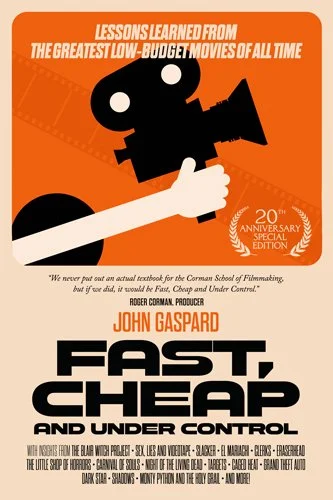
Dying to make a feature? Learn from the pros!
When Fast, Cheap & Under Control first hit shelves in 2006, it became the underground handbook for a generation of indie filmmakers. Now, two decades on, this 20th Anniversary Special Edition proves the lessons inside aren't just timeless—they're more essential than ever.
What's changed? Technology. Platforms. Distribution.
What hasn't? The grit, ingenuity, and sheer determination it takes to make a great film with nothing but vision and hustle.
Inside, you'll find:
Exclusive interviews with legends like Steven Soderbergh, Roger Corman, Jon Favreau, Henry Jaglom, Kasi Lemons, Dan O'Bannon, Bob Odenkirk and more
Over 100 images bringing the stories to life
40+ links to trailers, scenes, and supplementary material—turning this book into an interactive master class
Real-world case studies from 33 groundbreaking low-budget films—from Clerks and El Mariachi to The Blair Witch Project and sex, lies, and videotape
Field-tested lessons from the author's own four features—proof that these principles work in the real world, on set, in the edit room, and on screen
Whether you're shooting on your phone or scraping together a micro-budget, this is your master class in turning limitations into strengths.
No film school required. Just this book.
Roger Corman called it the textbook for his legendary filmmaking school. Now it's your turn to learn from the best.

Write Your Screenplay with the Help of Top Screenwriters!
It’s like taking a Master Class in screenwriting … all in one book!
Discover the pitfalls of writing to fit a budget from screenwriters who have successfully navigated these waters already. Learn from their mistakes and improve your script with their expert advice.
"I wish I'd read this book before I made Re-Animator."
Stuart Gordon, Director, Re-Animator, Castle Freak, From Beyond
John Gaspard has directed half a dozen low-budget features, as well as written for TV, movies, novels and the stage.
The book covers (among other topics):
Academy-Award Winner Dan Futterman (“Capote”) on writing real stories
Tom DiCillio (“Living In Oblivion”) on turning a short into a feature
Kasi Lemmons (“Eve’s Bayou”) on writing for a different time period
George Romero (“Martin”) on writing horror on a budget
Rebecca Miller (“Personal Velocity”) on adapting short stories
Stuart Gordon (“Re-Animator”) on adaptations
Academy-Award Nominee Whit Stillman (“Metropolitan”) on cheap ways to make it look expensive
Miranda July (“Me and You and Everyone We Know”) on making your writing spontaneous
Alex Cox (“Repo Man”) on scaling the script to meet a budget
Joan Micklin Silver (“Hester Street”) on writing history on a budget
Bob Clark (“Children Shouldn’t Play with Dead Things”) on mixing humor and horror
Amy Holden Jones (“Love Letters”) on writing romance on a budget
Henry Jaglom (“Venice/Venice”) on mixing improvisation with scripting
L.M. Kit Carson (“Paris, Texas”) on re-writing while shooting
Academy-Award Winner Kenneth Lonergan (“You Can Count on Me”) on script editing
Roger Nygard (“Suckers”) on mixing genres
This is the book for anyone who’s serious about writing a screenplay that can get produced!