
When did you first get interested in acting?
DEBRA: I remember when I was very little being interested in plays and I used to read all the Tennessee Williams plays and all the Sam Shepard plays – all the books that my older sister had on her shelves. This was in elementary school. So I was always interested, always seeking out opportunities to be in plays. But I was never cast.
I think there are two kinds of actors. There’s the writer actor and then there’s the performer/singer actor. And I was always more into the writing of it. And I was always interested in writing, too. But my sister was a writer, and so I always felt like that was her territory. So I went into acting, even though I think for me I had the same feeling for writing.
Acting was very good for me for a lot of reasons, so I stayed with it. I would take the train into the city to take acting classes when I young, like fourteen. And then I majored in theater when I was in college and I went to special summer programs for acting – it was just what I did.
Then when I graduated from college, I started interning at Circle Rep, which I don’t think exists anymore. It was a pretty big off-Broadway theater at one time. And then I would go on auditions through Backstage. And I immediately started getting work in off-off-Broadway plays.

How did Oleanna come into your life?
DEBRA: I went to an open call for Oleanna, to understudy, and I got the part as the understudy. Then, after a few months of understudying, I had been rehearsing with David Mamet, who was putting in a new actress, and he offered me the part. So that’s how I broke into it, as far as making money and making my living.
From there I just kept getting work as an actress, so I was able to make a living. I did a lot of theater. I did the Wendy Wasserstein play, The Sisters Rosensweig, and then I did the movie The Heidi Chronicles and I did the movie of Oleannaand I was doing television and TV movies – I moved out to Los Angeles.
But the business of acting was not good for me. I wasn’t very happy and I didn’t understand it. Nobody taught me, there’s no book to prepare you for what it is. I had just been acting in classes, which I enjoyed. But auditioning for casting directors and dealing with agents – I was completely green. I had no idea how to deal with these people. I was pretty young, about twenty-three.
So I went to film school and I learned how to edit and I learned to do all the things you need to do to make a film. It really opened up a whole new world to me that I changed my life completely and I became a much happier person. Everything just fell into place in my life when I moved into film.
How did your low-budget feature, The Limbo Room, come about?
DEBRA: My sister and I had been working on a play. I really wanted to write a play about an understudy, because I had started understudying and it was this whole backstage world. The whole idea was just so bizarre to me: you’re trapped backstage while this play is going on out there. And you’re in this little room in the back and you have to listen to what’s going on out on the stage and you may (or may not) go on. There are just so many metaphors going on within the idea of an understudy.
When I was doing Oleanna, I was the understudy. When I walked into that play, David Mamet’s wife was the actress and she had been doing the play for a long time. And was suffering horribly from playing that role. Every night she got beat-up on stage and every night the audience would cheer. It’s just a hated character. And I thought that I would be immune to that. I played that role in Oleanna for a year and I realized, in retrospect, that it really did depress the hell out of me, playing that role night after night.
So that was one element I was interested in: what’s real and what’s not real and how you take on the character – you are this character but you aren’t this character. Then this whole microcosm that’s happening backstage with the understudies and the actors.
So we wrote The Limbo Room; we finished it in a summer, and then I shot that film in nine days.
And then I edited it over the course of a year. As soon as I finished the rough cut, I went into labor and had my baby. Then it went to Slamdance and the Sundance Channel has played it. It won some awards, too, so it’s not bad for nine days and $30,000 dollars.

What did you learn, as a filmmaker, from your work as an actress in the movie Oleanna?
DEBRA: I worked with David Mamet on the stage production; I had already done the play for a long time before I did the film. So it was like we were doing the play again when we did the film.
David’s method of working with actors is very different than my way of working with actors. He just basically gave me three Super Objectives for each act, which is kind of genius. So he said, “In this Act, you’re seeking help, in this one you’re doing this, in this one you’re doing that.” And that was really the extent of it.
The thing that I learned the most from David was how he led. He’s a great leader. And I think that’s what I took away from it.

How did he demonstrate that?
DEBRA: It was the way he treated everyone. He treated everyone with the utmost respect. It was a very tight ship; everyone felt like they were part of what was happening, from craft service to the grips. Everyone felt like they were special.
I’ve been on sets where people are really unhappy and miserable and cursing the director because he’s disrespectful. That’s what I learned from David, the way he respected everyone. And I think that’s probably one of the most important things to learn.
You’re their director, and people are not going to work for you and do the things you ask them to do if they’re feeling unappreciated. And he was really good at making everybody feel totally worthwhile and appreciated and important. That’s a lesson that could be easily overlooked, but when I compare it to other situations where the director is just not really present and not making everyone feel important and appreciated, it definitely shows.
In the past, I’ve been in a situation on shooting a movie where the director is just really rude and really disrespectful to the actors. And everyone takes their break and that’s what they’re talking about, they’re talking about how they’re feeling they’re being disrespected. And then it shows up in the scene. It’s like a domino effect.
David’s a very, very smart man and he knows exactly what he needs to do to make everybody feel good. I think that’s his strongest thing as a director and that was the biggest lesson I learned on that film.


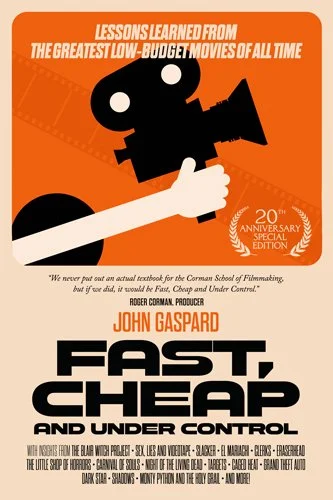
Dying to make a feature? Learn from the pros!
When Fast, Cheap & Under Control first hit shelves in 2006, it became the underground handbook for a generation of indie filmmakers. Now, two decades on, this 20th Anniversary Special Edition proves the lessons inside aren't just timeless—they're more essential than ever.
What's changed? Technology. Platforms. Distribution.
What hasn't? The grit, ingenuity, and sheer determination it takes to make a great film with nothing but vision and hustle.
Inside, you'll find:
Exclusive interviews with legends like Steven Soderbergh, Roger Corman, Jon Favreau, Henry Jaglom, Kasi Lemons, Dan O'Bannon, Bob Odenkirk and more
Over 100 images bringing the stories to life
40+ links to trailers, scenes, and supplementary material—turning this book into an interactive master class
Real-world case studies from 33 groundbreaking low-budget films—from Clerks and El Mariachi to The Blair Witch Project and sex, lies, and videotape
Field-tested lessons from the author's own four features—proof that these principles work in the real world, on set, in the edit room, and on screen
Whether you're shooting on your phone or scraping together a micro-budget, this is your master class in turning limitations into strengths.
No film school required. Just this book.
Roger Corman called it the textbook for his legendary filmmaking school. Now it's your turn to learn from the best.

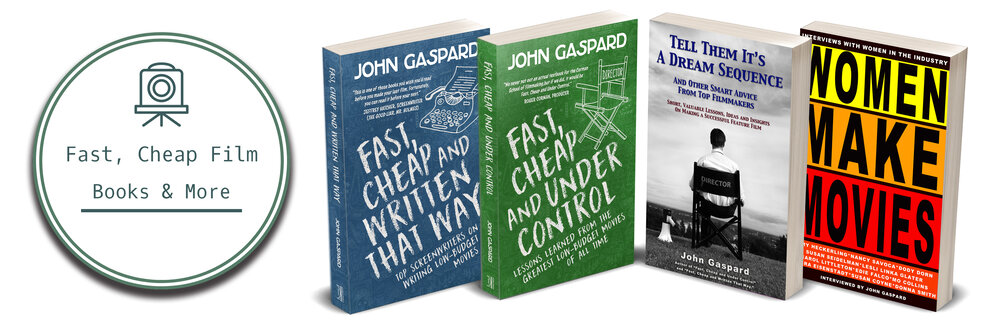
Write Your Screenplay with the Help of Top Screenwriters!
It’s like taking a Master Class in screenwriting … all in one book!
Discover the pitfalls of writing to fit a budget from screenwriters who have successfully navigated these waters already. Learn from their mistakes and improve your script with their expert advice.
"I wish I'd read this book before I made Re-Animator."
Stuart Gordon, Director, Re-Animator, Castle Freak, From Beyond
John Gaspard has directed half a dozen low-budget features, as well as written for TV, movies, novels and the stage.
The book covers (among other topics):
Academy-Award Winner Dan Futterman (“Capote”) on writing real stories
Tom DiCillio (“Living In Oblivion”) on turning a short into a feature
Kasi Lemmons (“Eve’s Bayou”) on writing for a different time period
George Romero (“Martin”) on writing horror on a budget
Rebecca Miller (“Personal Velocity”) on adapting short stories
Stuart Gordon (“Re-Animator”) on adaptations
Academy-Award Nominee Whit Stillman (“Metropolitan”) on cheap ways to make it look expensive
Miranda July (“Me and You and Everyone We Know”) on making your writing spontaneous
Alex Cox (“Repo Man”) on scaling the script to meet a budget
Joan Micklin Silver (“Hester Street”) on writing history on a budget
Bob Clark (“Children Shouldn’t Play with Dead Things”) on mixing humor and horror
Amy Holden Jones (“Love Letters”) on writing romance on a budget
Henry Jaglom (“Venice/Venice”) on mixing improvisation with scripting
L.M. Kit Carson (“Paris, Texas”) on re-writing while shooting
Academy-Award Winner Kenneth Lonergan (“You Can Count on Me”) on script editing
Roger Nygard (“Suckers”) on mixing genres
This is the book for anyone who’s serious about writing a screenplay that can get produced!