
I think the first reel of The Big Chill is one of the best first reels in movie history. Everything is set up so nicely.
CAROL LITTLETON: Right. All the characters are introduced.
Let me ask -- and this is just because I've always been curious about this -- William Hurt walks into the church in that reel just at the Minister is saying, ".... a man like Alex." Was that juxtaposition in the script or was it found in the editing?
CAROL LITTLETON: That was found in the editing. We could have had those entrances anywhere, in any order. Obviously he was the last one to arrive. We did cut the minister's speech down some, it was a little bit rambling. And it was just more salient to have the line over the Bill Hurt character, Nick, as he sits down.

Was that film similar to Body Heat, in that you found a lot of it in the editing room?
CAROL LITTLETON: It stayed closed to the script than Body Heat, because it was not a thriller. So we didn't have to deal with elements of timing that are alive on film but on the page are sometimes hard to judge.
But we had other things that were equally difficult, and that was how to integrate the music into the scenes and have it make sense. We discovered right away that we would not have a score, that it would be just the music from Motown stuff and things that were popular in 1968-69.
There were only two tunes that were in the script that we did to playback. For the rest of them, I cut the music and then cut the picture to the music. That was, essentially, doing it backwards. Those were not needle drops that we did after the picture was done and we just added it. It was all integrated as we were going.
I had probably 150 tunes that were in my editing room, on a rack. I would try a lot of different things until we found the right tempo and the right piece. Of course, Larry is very knowledgeable about rock and roll and that era, because he was in college then.
So most of our editorial time went into the stylistic elements of making the film. Making the music choices seem seamless and making it flow from one song to the next, so that the lyrics and the tempo and the musicality of the scene matched. Like I said, they weren't needle drops; everything was cut to the tempo of the music and re-arranged in such a way that the lyrics fell at certain moments that were salient moments in the film.
So you're kind of doing it backwards; you're literally laying the track out and putting the picture to it, rather than cutting the picture and just dropping the music in. It makes a very big difference in the flow of the film, the musicality of the film, the style of it. The style of the picture is, in fact, very musical. So those were the challenges, editorially; it was really questions of style more than anything else.
Do you have a favorite moment, where it all came together?
CAROL LITTLETON: Yes, I think the episode that was very, very difficult was with the character of Meg (Mary Kay Place) who wants to have a baby. And when Glenn Close figures out that she could put her husband with her best friend, well, it's a little preposterous. This was before artificial insemination, so if you were going to have a baby, you actually had to have a partner. We knew that it was a little far-fetched and if the audience lost it in the movie it would probably be with that episode. The humor had to play a large part in allowing the audience to feel that it was appropriate and slightly goofy and also believable and tasteful.
So I think that whole section, with Aretha Franklin's "A Natural Woman," that whole section into the next morning, I felt really worked well for me. The night before, during the night and the next morning.

Let's talk about one of the most famous scenes in the movie -- the ending flashback, with Kevin Costner as Alex, that was shot but then cut from the movie. How did that come about?
CAROL LITTLETON: You could talk to five or six different people who worked on the movie and you'd get several different opinions. But being on the inside of that, the ending that Larry and Barbara Benedek wrote was to have a large flashback at the very end of how all these people were -- the roots of their personalities, the roots of who they were going to be -- were actually evident when they were students.
After I first read the script, we sat down and I said, "I feel very uneasy about this flashback. I just don't think you need it." And Larry with his nasal, West Virginia voice, said, "Carol, I can't believe you said that. You are so wrong. I can't believe it. You are so wrong." So I dropped it. When somebody says you're wrong, you drop it.
When we were shooting it I said, "This looks like a masquerade, with everybody in long hair and beads." And Larry said, "Carol, you are so wrong. The reason I wanted to write this script was because of this idea." And I said, "Yes, Larry, you're absolutely right. It's a wonderful idea. You may have needed that scene to write the script, but you don't need the scene for the movie. At all." "You are so wrong, if you mention this one more time!"
Well, in the editing, we put that flashback everywhere. We took it out of the ending, we put it up front, we put it in the middle, we put it in pieces, we spent a lot of time trying to get the flashback to work.
We showed it to the studio with the flashback and the suits came in -- Larry and I were the only people from our end -- and the guy who was in charge said, "This is not funny. Take it back, re-do it. I don't know what you guys are thinking, this is a comedy? This is bullshit. Start over again."
Well, we were devastated. Devastated. We knew it was funny, we knew it was engaging, we knew it was emotional.
And then he said, "While you're at it, that flashback is a stinko scene."
So we showed it to them the next time with an audience and the movie still did not work as well as it should. So I said, "Larry, why don't we devise an ending, drop the flashback, have two screenings -- one with the flashback and one without -- and let the audience tell us which one is more effective?"
Well, at the screenings, it was clear that the version without the flashback was better. And the next day, when Larry came into the cutting room, he said, "God dammit, Carol, I wanted you to take that thing out from the beginning! How many times do I have to tell you I'm right?"
That's how funny he is. He's wonderful.


Dying to make a feature? Learn from the pros!
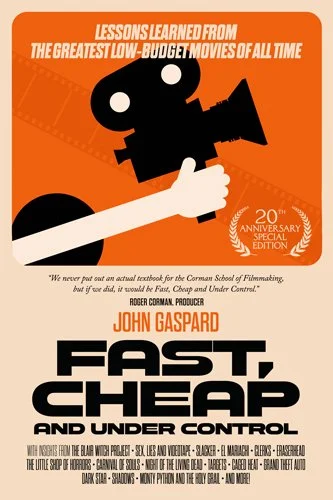
When Fast, Cheap & Under Control first hit shelves in 2006, it became the underground handbook for a generation of indie filmmakers. Now, two decades on, this 20th Anniversary Special Edition proves the lessons inside aren't just timeless—they're more essential than ever.
What's changed? Technology. Platforms. Distribution.
What hasn't? The grit, ingenuity, and sheer determination it takes to make a great film with nothing but vision and hustle.
Inside, you'll find:
Exclusive interviews with legends like Steven Soderbergh, Roger Corman, Jon Favreau, Henry Jaglom, Kasi Lemons, Dan O'Bannon, Bob Odenkirk and more
Over 100 images bringing the stories to life
40+ links to trailers, scenes, and supplementary material—turning this book into an interactive master class
Real-world case studies from 33 groundbreaking low-budget films—from Clerks and El Mariachi to The Blair Witch Project and sex, lies, and videotape
Field-tested lessons from the author's own four features—proof that these principles work in the real world, on set, in the edit room, and on screen
Whether you're shooting on your phone or scraping together a micro-budget, this is your master class in turning limitations into strengths.
No film school required. Just this book.
Roger Corman called it the textbook for his legendary filmmaking school. Now it's your turn to learn from the best.

Write Your Screenplay with the Help of Top Screenwriters!
It’s like taking a Master Class in screenwriting … all in one book!
Discover the pitfalls of writing to fit a budget from screenwriters who have successfully navigated these waters already. Learn from their mistakes and improve your script with their expert advice.
"I wish I'd read this book before I made Re-Animator."
Stuart Gordon, Director, Re-Animator, Castle Freak, From Beyond
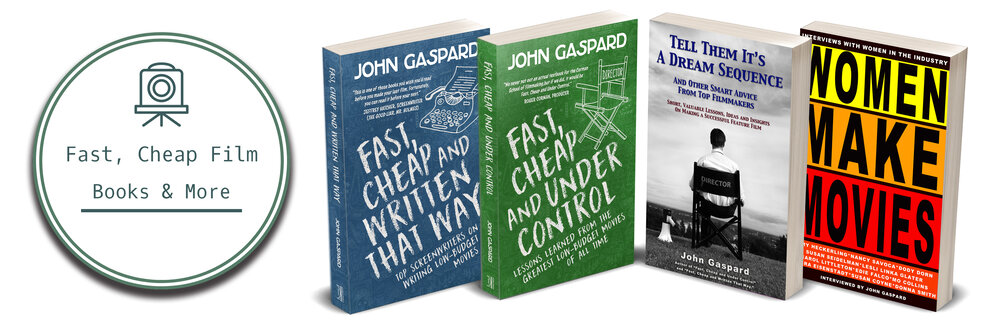
John Gaspard has directed half a dozen low-budget features, as well as written for TV, movies, novels and the stage.
The book covers (among other topics):
Academy-Award Winner Dan Futterman (“Capote”) on writing real stories
Tom DiCillio (“Living In Oblivion”) on turning a short into a feature
Kasi Lemmons (“Eve’s Bayou”) on writing for a different time period
George Romero (“Martin”) on writing horror on a budget
Rebecca Miller (“Personal Velocity”) on adapting short stories
Stuart Gordon (“Re-Animator”) on adaptations
Academy-Award Nominee Whit Stillman (“Metropolitan”) on cheap ways to make it look expensive
Miranda July (“Me and You and Everyone We Know”) on making your writing spontaneous
Alex Cox (“Repo Man”) on scaling the script to meet a budget
Joan Micklin Silver (“Hester Street”) on writing history on a budget
Bob Clark (“Children Shouldn’t Play with Dead Things”) on mixing humor and horror
Amy Holden Jones (“Love Letters”) on writing romance on a budget
Henry Jaglom (“Venice/Venice”) on mixing improvisation with scripting
L.M. Kit Carson (“Paris, Texas”) on re-writing while shooting
Academy-Award Winner Kenneth Lonergan (“You Can Count on Me”) on script editing
Roger Nygard (“Suckers”) on mixing genres
This is the book for anyone who’s serious about writing a screenplay that can get produced!