How did you get started in filmmaking?
MIHM: After a lifetime of wanting to but never having enough motivation, I officially began making movies in 2005. In 2004, my 13-year-old stepdaughter was diagnosed with bone cancer (of which, she is now 100% cured some eight years later), I decided it was time to finally get moving on realizing my own dreams because, after all, if a healthy, athletic 13-year-old kid could be diagnosed with a potentially fatal disease, I, as an overweight 30-year-old, could easily be next!
So, shaken out of my complacency, I sat down and wrote the screenplay for my first film, "The Monster of Phantom Lake." Driven to finally make a "real movie," I plowed through and completed it within about six months. The following spring, I held a premiere at The Heights Theatre on the outskirts of Minneapolis, MN to a raucous and excited audience. The film quickly garnered many positive reviews and screened in many events and film festivals across the world. Completely addicted to the experience, I decided I had to keep making movies, no matter what the cost!
Why are you drawn to Fifties-style monster movies?
MIHM: I made my first film as a tribute to my late father. When I was growing up, he and I would bond by watching those cheesy old movies together. He passed away in 2000 from a rare form of stomach cancer and had been on my mind quite a bit when my stepdaughter was diagnosed just four years later. I felt like I wanted to make a movie that my dad would have loved and one he and I would have enjoyed watching together. This is where "The Monster of Phantom Lake" came from.
After releasing it, I had the opportunity to screen it at a drive-in in Wisconsin. Seeing it up on that giant drive-in screen was transcendent! Experiencing my cheesy 1950s-style B-movie at a drive-in is one of the greatest moments of my life because it was THE perfect place to see it. I literally rank that experience up there with the births of my children! During that screening I had an epiphany and decided I didn't want to do anything other than these retro-style features.

What is your writing process like?
MIHM: A lot of times it starts with an idea or even just a title. If something really strikes me, I’ll make a point to just sit down WRITE as much as possible and as fast as possible, never wanting to lose momentum. If I get stuck, I’ll step back and sleep on it. Once finished, rarely do I go back and judiciously edit things after I finish the first draft. Since I’m making cheesy B-movies, I actually don’t want them to be “too perfect.” I like flaws. I feel they add to the authenticity of what I’m trying to accomplish!
You wear a lot of hats on your productions -- what's the upside and downside of doing that?
MIHM: The upside, obviously, is control. I can do what I want and make things look or sound or feel EXACTLY the way I want them to. This allows my movies to be more “me.” In the beginning, I really didn’t collaborate much. Lately (and partially because the scope of my films has increased quite a bit), I’m finding myself much more open to collaboration. The downside to doing so much myself is burn-out (and/or taking on too much) AND not being able to blame anyone else when they fail! (Not that I would blame anyone else because, ultimately, I’m the “Captain of the ship,” and I will ALWAYS go down with the ship!)

What inspired "The Giant Spider"?
MIHM: My son had a pet gecko that, sadly, passed away. On a trip to the pet store to find a “replacement,” he chose a tarantula. I was fine with his choice. My wife… not so much! Ultimately, we bought it and, upon getting it home, I actually said out loud, “That’s the star of my next movie.” Since “big bug” movies were all the rage in the 1950s, it seemed appropriate that I would have to do one eventually. This just seemed like the perfect time!
What's your secret for creating special effects on a very low budget?
MIHM: Make cheesy 1950s B-movies where the special effects don’t need to be particularly “special!” But seriously, find creative people with appropriate talents they’re willing to share. I’ve been lucky over my years of making movies to find several extremely talented individuals who enjoy making these kinds of films and are willing to do it for little to no pay. I’d feel bad that these wonderful people are essentially working for free but I’m not really making any money, either, so… we’re even, I guess! Also, there are online tutorials on how to do anything you would ever need (special effects-wise) and I encourage everyone to take advantage of them!
What camera package do you use and what did you love and hate about it?
MIHM: The first six films I made I used a Panasonic DVX-100A. Since my seventh film (“House of Ghosts”), I upgraded to the AVC-HD equivalent, the Panasonic HMC-150. To be honest, I have no complaints about it so far. I’ve made two films with it and haven’t had any negative issues SO FAR. It’s light, easy-to-use, records onto high-capacity SD cards, the full-HD video quality and in-camera sound capabilities are outstanding and it offers many, MANY options that make it possible to do almost anything you would need to make a low-budget film that looks like it cost A LOT more!
What was the smartest thing you did during this last production? The dumbest?
MIHM: The smartest thing I did was lean on my production team as much as I did. The scope of “The Giant Spider” is far larger than anything I’ve ever attempted, and I honestly don’t think I could have pulled it off without them!
The dumbest was putting myself into a role that required several scenes. I put myself in every one of my films in some SMALL capacity (because Hitchcock did it!), usually just a voice on a radio or something similar. For some reason, I thought it’d be fun to actually give myself a character with three scenes. I’m not really much of an actor (AT ALL) and it just added an extra level of stress that I REALLY didn’t need!


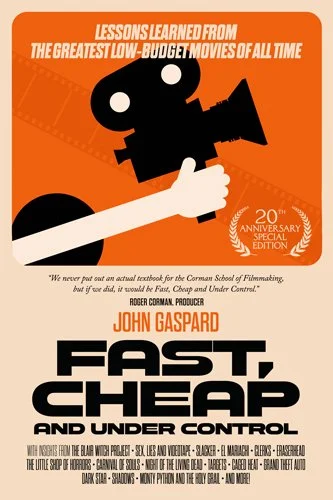
Dying to make a feature? Learn from the pros!
When Fast, Cheap & Under Control first hit shelves in 2006, it became the underground handbook for a generation of indie filmmakers. Now, two decades on, this 20th Anniversary Special Edition proves the lessons inside aren't just timeless—they're more essential than ever.
What's changed? Technology. Platforms. Distribution.
What hasn't? The grit, ingenuity, and sheer determination it takes to make a great film with nothing but vision and hustle.
Inside, you'll find:
Exclusive interviews with legends like Steven Soderbergh, Roger Corman, Jon Favreau, Henry Jaglom, Kasi Lemons, Dan O'Bannon, Bob Odenkirk and more
Over 100 images bringing the stories to life
40+ links to trailers, scenes, and supplementary material—turning this book into an interactive master class
Real-world case studies from 33 groundbreaking low-budget films—from Clerks and El Mariachi to The Blair Witch Project and sex, lies, and videotape
Field-tested lessons from the author's own four features—proof that these principles work in the real world, on set, in the edit room, and on screen
Whether you're shooting on your phone or scraping together a micro-budget, this is your master class in turning limitations into strengths.
No film school required. Just this book.
Roger Corman called it the textbook for his legendary filmmaking school. Now it's your turn to learn from the best.

Write Your Screenplay with the Help of Top Screenwriters!
It’s like taking a Master Class in screenwriting … all in one book!
Discover the pitfalls of writing to fit a budget from screenwriters who have successfully navigated these waters already. Learn from their mistakes and improve your script with their expert advice.
"I wish I'd read this book before I made Re-Animator."
Stuart Gordon, Director, Re-Animator, Castle Freak, From Beyond
John Gaspard has directed half a dozen low-budget features, as well as written for TV, movies, novels and the stage.
The book covers (among other topics):
Academy-Award Winner Dan Futterman (“Capote”) on writing real stories
Tom DiCillio (“Living In Oblivion”) on turning a short into a feature
Kasi Lemmons (“Eve’s Bayou”) on writing for a different time period
George Romero (“Martin”) on writing horror on a budget
Rebecca Miller (“Personal Velocity”) on adapting short stories
Stuart Gordon (“Re-Animator”) on adaptations
Academy-Award Nominee Whit Stillman (“Metropolitan”) on cheap ways to make it look expensive
Miranda July (“Me and You and Everyone We Know”) on making your writing spontaneous
Alex Cox (“Repo Man”) on scaling the script to meet a budget
Joan Micklin Silver (“Hester Street”) on writing history on a budget
Bob Clark (“Children Shouldn’t Play with Dead Things”) on mixing humor and horror
Amy Holden Jones (“Love Letters”) on writing romance on a budget
Henry Jaglom (“Venice/Venice”) on mixing improvisation with scripting
L.M. Kit Carson (“Paris, Texas”) on re-writing while shooting
Academy-Award Winner Kenneth Lonergan (“You Can Count on Me”) on script editing
Roger Nygard (“Suckers”) on mixing genres
This is the book for anyone who’s serious about writing a screenplay that can get produced!