What was your filmmaking background before making "A Short History of Drugs in the Valley"?
Brent: This is my fourth feature film. I have done many commercials, some music videos, web series and shorts.
Where did the idea come from and what was the process for writing the script and getting the script ready to shoot?
Brent: The idea came from growing up in a small town and the stories that you hear or are told growing up. People love to idealize how peaceful and joyous small-town life is, but often it's as unpredictable a place as anywhere else.
I wrote the film. It was a combination of two scripts I had. I decided to combine and refine the two stories, which is a total independent film thing to do. My wife and I collaborate on many of our projects, and we had decided to do another feature (this is now my fourth) after she had just completed a personal short film that I produced. So, we agreed to do this film that I had wanted to do.
Combining the two screenplays and adding some more scenes was the bulk of my writing which I did over a three-month period. Knowing that I am shooting it with actors who I've worked with before and producing it ourselves, the screenplay is definitely not a completed project. Plenty of room to work in setting the scenes and tweaking dialogue. It wouldn't win any screenwriting contests, that's for sure.
What was your casting process, and did you change the script to match your final cast?
Brent: Casting was all hand selected. We did not audition anyone. We'd worked with many of them in other projects before. The rest came out of my wife's improv classes or local community theater actors I'd seen perform.
We only made minor changes. The biggest change was that my wife, who is a successful commercial and theatrical actor, was also producing the film with me (we work in tandem on many projects) decided to reduce her role and we cut it down in the script considerably to make the story flow better and add extra shooting time for the remainder of the script.
What type of camera did you use and what did you love (and hate) about it?
Brent: A Canon 6D and a few scenes with a Canon 5D Mark III. The cinematographers did all the shooting, so I just trusted their comfortability and vision.
Did the movie change much in the editing, and if so, why did you make the changes?
Brent: The editor (Lee Bacak) gave me two cuts after his first pass. One was close to what I had in the script and the other was his ideal version. We went with his version because it was very concise, clear and only about 5 to 6 minutes shorter. Turned out to be a good choice.
Can you talk about your distribution plan for recouping costs?
Brent: Our initial plan was pretty undetermined. I work in the YouTube ecosystem in various capacities, and I hoped that with the recognition of the musicians involved that getting it up on our YouTube would give us some nice views and maybe a bit of ad dollars. But getting released on Amazon changed all that of course.
What impact did the length of the movie (around 50 minutes) have on getting a distributor interested?
Brent: When the editor and I settled on the final cut, the Youtube route (and possibly using the film as a "pilot" for a sequel or series) seemed like the obvious direction we were going to go.
I had another film in The Rhode Island International Film Festival and met an Amazon Video representative there and they said they'd look at it. Getting a micro-budget film of this length up on Amazon is just a testament to the changing world of independent film.
What was the smartest thing you did during production? The dumbest?
Brent: Smartest- There are so many. Haha. I have to list two.
One, casting actors I trusted and giving them the space to do what they are best at.
Two, scheduling in extra half-days of shooting as buffers even though it was hard to make that happen. We shot in two time blocks: six days, then a week off and then six more days. I needed the extra half day during the first time block. We did not need it in the second and it just became a time to experiment in the final scene of the day and give everyone a couple extra hours to relax and sleep.
Dumbest- There are so many! Again, I'll have to list two.
One, not confirming my shoot with a local State Park that I had gotten a permit for. The ranger on duty had no clue what was happening and shut us down. That is when we had to use one of those buffer half-days and shoot at a local farm instead.
Two, not keeping up with all the dailies and confirming I got everything I wanted/needed.
And, finally, what did you learn from making this feature that you will take to other projects?
Brent: Going with your instinct on length, structure and approach concerning the final product. With the changing landscape there are viable homes on quality platforms for all types of projects.


Dying to make a feature? Learn from the pros!
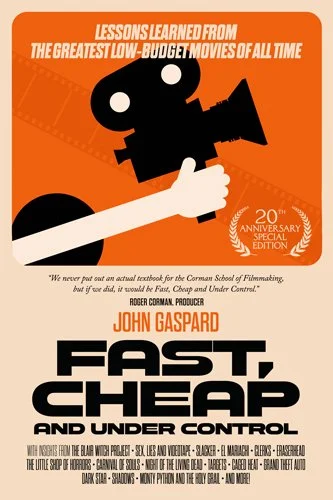
When Fast, Cheap & Under Control first hit shelves in 2006, it became the underground handbook for a generation of indie filmmakers. Now, two decades on, this 20th Anniversary Special Edition proves the lessons inside aren't just timeless—they're more essential than ever.
What's changed? Technology. Platforms. Distribution.
What hasn't? The grit, ingenuity, and sheer determination it takes to make a great film with nothing but vision and hustle.
Inside, you'll find:
Exclusive interviews with legends like Steven Soderbergh, Roger Corman, Jon Favreau, Henry Jaglom, Kasi Lemons, Dan O'Bannon, Bob Odenkirk and more
Over 100 images bringing the stories to life
40+ links to trailers, scenes, and supplementary material—turning this book into an interactive master class
Real-world case studies from 33 groundbreaking low-budget films—from Clerks and El Mariachi to The Blair Witch Project and sex, lies, and videotape
Field-tested lessons from the author's own four features—proof that these principles work in the real world, on set, in the edit room, and on screen
Whether you're shooting on your phone or scraping together a micro-budget, this is your master class in turning limitations into strengths.
No film school required. Just this book.
Roger Corman called it the textbook for his legendary filmmaking school. Now it's your turn to learn from the best.

Write Your Screenplay with the Help of Top Screenwriters!
It’s like taking a Master Class in screenwriting … all in one book!
Discover the pitfalls of writing to fit a budget from screenwriters who have successfully navigated these waters already. Learn from their mistakes and improve your script with their expert advice.
"I wish I'd read this book before I made Re-Animator."
Stuart Gordon, Director, Re-Animator, Castle Freak, From Beyond
John Gaspard has directed half a dozen low-budget features, as well as written for TV, movies, novels and the stage.
The book covers (among other topics):
Academy-Award Winner Dan Futterman (“Capote”) on writing real stories
Tom DiCillio (“Living In Oblivion”) on turning a short into a feature
Kasi Lemmons (“Eve’s Bayou”) on writing for a different time period
George Romero (“Martin”) on writing horror on a budget
Rebecca Miller (“Personal Velocity”) on adapting short stories
Stuart Gordon (“Re-Animator”) on adaptations
Academy-Award Nominee Whit Stillman (“Metropolitan”) on cheap ways to make it look expensive
Miranda July (“Me and You and Everyone We Know”) on making your writing spontaneous
Alex Cox (“Repo Man”) on scaling the script to meet a budget
Joan Micklin Silver (“Hester Street”) on writing history on a budget
Bob Clark (“Children Shouldn’t Play with Dead Things”) on mixing humor and horror
Amy Holden Jones (“Love Letters”) on writing romance on a budget
Henry Jaglom (“Venice/Venice”) on mixing improvisation with scripting
L.M. Kit Carson (“Paris, Texas”) on re-writing while shooting
Academy-Award Winner Kenneth Lonergan (“You Can Count on Me”) on script editing
Roger Nygard (“Suckers”) on mixing genres
This is the book for anyone who’s serious about writing a screenplay that can get produced!