
What was your filmmaking background before making "Croaker?"
TERLING: I've done several shorts, participated in the 48-hour film festival and worked on a couple of projects for friends, both editing and acting. I've Produced and hosted an online international independent film showcase, "Barnabus Bailey and the Greatest Show Unearthed." Think Vampira or Zacherly, but screening Indy's instead of the old public domain films. I've written forever.
Where did the idea come from and what was the writing process like ?
TERLING: I wanted to do something that was personal. I went back to my hometown and visited all of the locations of my youth. There was something that happened with the emotions and the memories that sort of coalesced this story.
In my mancave, there is a pretty substantial folklore and monster library that served as a reference to pick just the right creature that fit the very ethnic diversity of my hometown. I've been writing since fourth grade, I love it. Ernest Hemingway said, “The first draft of anything is shit." That quote is my guidepost. I look more at a script as something that is alive, gestated through the process of the film. Actors get into their roles and the more they become that character, they breathe life into the words and often go off script. As a Director, I know I am doing my job when this happens.

Can you talk about how you raised your budget and your financial plan for recouping your costs?
TERLING: I have a background in political fundraising and one thing I learned early on from my mentors, NEVER put you eggs in one basket. It was a multi-tiered approach based on an analysis of potential donors, fence sitters and unknowns. By targeting specific groups with specific offerings, I developed an investment package that I could present to very specific donors, the kinds of people who wouldn't jump at a larger number. The fence sitters always need a little coaxing, so a lower offering was made to that group. Advertisers and product placement, since we shot locally, was also effective.
One of the questions that came up early on in the process was, "I can't afford the investor amount, but would like to help out, where can I donate?' That's where crowd funding came in. We used Indiegogo and I was pleasantly surprised with how many people came through that channel.
What kind of camera did you use to shoot the movie -- and what did you love about it and hate about it?
TERLING: Old reliable, Sony HDR FX1, a Nikon D3200 and Panasonic HVX 200. What I loved is the video quality, even at night and of course the ease of using filters as we have a TON of exterior—natural lighting shots. Didn't hate anything really. Audio is always a concern running three different cameras. Converting the MXF files on the HV is a pain, but not a big deal.

You wore a lot of hats on this project -- director, writer, producer, editor. What's the upside and the downside of working that way?
TERLING: Great question. The upside is, when doing a personal story that I created from images and emotions, the creative process of directing, writing and editing keeps the story continuity intact. The story is kind of complex as we have a curse, a monster, very developed characters, humor, a love story and at the center of it all, a longing for connection between two brothers that was cut short by an incident twenty years prior. To put that in anyone else's hands and maintain the integrity of the film, I think is impossible.
The downside, of course, is that one additional hat - Production. Handling all the administrative tasks can be simply overwhelming. Trying to summon energy to step on the set after spending the day talking to an investor, securing a location and talking to the attorney, it was a challenge at times shifting gears. With that being said, from the ashes spawned the phoenix. Somewhere Hitch smiled on me and I was blessed with the greatest AD, Jennifer Obed and best production staff, Marty Patterson, Lori Terling, Jimmy Star, Jordan Strope, Tara Patterson and Pam Bolger, that a first time feature filmmaker could possibly have. They are the best - PERIOD. They turned any downside into an express elevator going up.
What was the smartest thing you did during production? The dumbest?
TERLING: Smartest thing - the team. No matter how personal a project is to you, it's essential to get everyone on board to more than just see the vision, but to make it their own. We have professionals on both sides of the camera, and they understand what it takes to get the shot. We worked so in concert together, a lot of the crew direction faded, and we sort of were on mind share. I am an incredibly patient person and I think that trickled down as all of the actors were very patient with each other.
The dumbest? Simple...time management - that and trusting my battery indicator! Between call time and shoot time, well, as an ex-Marine I'm sure one of my past commanders would have had me doing push-ups until I crashed! It was probably the greatest significant thing I learned on this film. Take how long you "think" something will take and triple it!
And, finally, what did you learn from making the film that you have taken to other projects?
TERLING: Locations are fun to shoot in, but time is limited. Sets are more relaxed and there is no time pressure. We had a ton of location shoots in Croaker and for the next film we are definitely going to rent space long term and build our sets. The creativity level and energy goes WAY up with the actors when we have no rush to shoot and get out, there are facilities and electricity is close at hand.


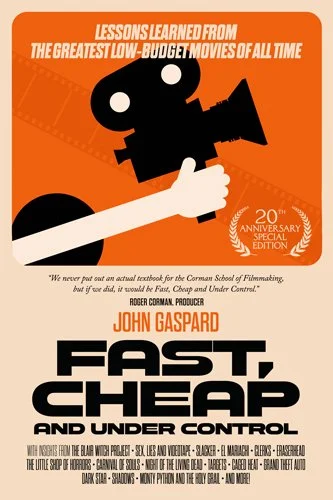
Dying to make a feature? Learn from the pros!
When Fast, Cheap & Under Control first hit shelves in 2006, it became the underground handbook for a generation of indie filmmakers. Now, two decades on, this 20th Anniversary Special Edition proves the lessons inside aren't just timeless—they're more essential than ever.
What's changed? Technology. Platforms. Distribution.
What hasn't? The grit, ingenuity, and sheer determination it takes to make a great film with nothing but vision and hustle.
Inside, you'll find:
Exclusive interviews with legends like Steven Soderbergh, Roger Corman, Jon Favreau, Henry Jaglom, Kasi Lemons, Dan O'Bannon, Bob Odenkirk and more
Over 100 images bringing the stories to life
40+ links to trailers, scenes, and supplementary material—turning this book into an interactive master class
Real-world case studies from 33 groundbreaking low-budget films—from Clerks and El Mariachi to The Blair Witch Project and sex, lies, and videotape
Field-tested lessons from the author's own four features—proof that these principles work in the real world, on set, in the edit room, and on screen
Whether you're shooting on your phone or scraping together a micro-budget, this is your master class in turning limitations into strengths.
No film school required. Just this book.
Roger Corman called it the textbook for his legendary filmmaking school. Now it's your turn to learn from the best.

Write Your Screenplay with the Help of Top Screenwriters!
It’s like taking a Master Class in screenwriting … all in one book!
Discover the pitfalls of writing to fit a budget from screenwriters who have successfully navigated these waters already. Learn from their mistakes and improve your script with their expert advice.
"I wish I'd read this book before I made Re-Animator."
Stuart Gordon, Director, Re-Animator, Castle Freak, From Beyond
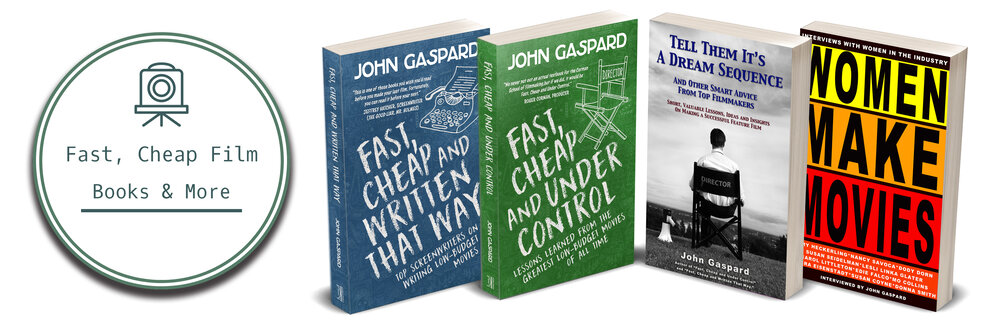
John Gaspard has directed half a dozen low-budget features, as well as written for TV, movies, novels and the stage.
The book covers (among other topics):
Academy-Award Winner Dan Futterman (“Capote”) on writing real stories
Tom DiCillio (“Living In Oblivion”) on turning a short into a feature
Kasi Lemmons (“Eve’s Bayou”) on writing for a different time period
George Romero (“Martin”) on writing horror on a budget
Rebecca Miller (“Personal Velocity”) on adapting short stories
Stuart Gordon (“Re-Animator”) on adaptations
Academy-Award Nominee Whit Stillman (“Metropolitan”) on cheap ways to make it look expensive
Miranda July (“Me and You and Everyone We Know”) on making your writing spontaneous
Alex Cox (“Repo Man”) on scaling the script to meet a budget
Joan Micklin Silver (“Hester Street”) on writing history on a budget
Bob Clark (“Children Shouldn’t Play with Dead Things”) on mixing humor and horror
Amy Holden Jones (“Love Letters”) on writing romance on a budget
Henry Jaglom (“Venice/Venice”) on mixing improvisation with scripting
L.M. Kit Carson (“Paris, Texas”) on re-writing while shooting
Academy-Award Winner Kenneth Lonergan (“You Can Count on Me”) on script editing
Roger Nygard (“Suckers”) on mixing genres
This is the book for anyone who’s serious about writing a screenplay that can get produced!